

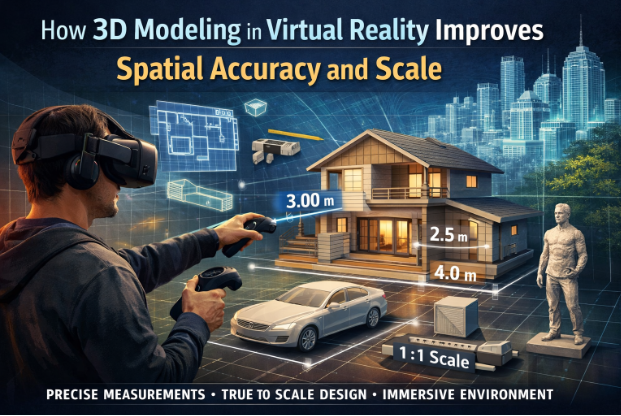
In the product design industry, the understanding of space is one of the toughest challenges. Architecture, product designs, or even the virtual spaces that can be created, if the understanding of space is not accurate, it leads to costly redesign.
Most of the workflows involved in screens cause a designer to analyze concepts of depth, scale, and distance in his/her intellect. Limitations caused by the latter factor contribute to why 3D modeling in Virtual Reality is becoming a preferable option for achieving a high degree of accuracy in scale.
As virtual reality brings designers right into their designs, it alters the manner in which space is considered, visualized, appraised, and optimized. This new experience signifies the reinterpretation of accuracy for modern designers.
Spatial Accuracy in Design Workflows: An Explanation
Spatial accuracy, therefore, can be defined as the extent to which the digital design recreates the measurements, proportions, and relationships of the real world. The traditional modeling software works on the principles of measurements, use of the grid, and the camera view in terms of dimension, which, although functional, is very interpretative.
In virtual reality, much of this trial and error is removed by the immersive three-dimensional modeling. The designer does not have to wonder how big or small something is going to feel, but is able to directly see and feel it themselves, and their spatial awareness improves significantly as a result.
Experience True-to-Scale Design in Real-Time Operation
One of the benefits that has the greatest impact in immersive workflows relates to scale. Instead of miniaturizing the data and viewing it on a screen, objects are scaled in the human dimension. The designer is able to assess the scale of the design from the inception.
In a virtual world, designers can walk around the objects, see them from various angles, and assess the placement of various objects. Awareness of scale helps to avoid common mistakes such as scaling objects too big or too small.
Reducing Errors from Screen-Based Interpretation
The flatscreens impair the perception of depth of the observer. To provide an informed estimate regarding size in this respect, it is largely dependent on zoom factors and perspective views.
The result is a tremendous number of false estimates regarding the size, which were only detectable later on when changes became more expensive.
Immersive environments mitigate such a problem by having the digital model replicate the manner in which humans perceive the world. The capacity of virtual reality designers to immediately recreate something in 3D through their designs in a virtual world simply lets the designers know immediately whether the area appears cramped, a bit looks too large, and the space for the passage of elements can be sufficient.
Enhancing the Accuracy of Complex Spatial Relations
In most complex projects, there are often multiple levels, parts, or systems that must spatially coordinate with one another. In some cases, it could be hard for an ordinary software to understand how these levels coordinate with each other.
Virtual reality facilitates the exploration of relationships between spaces in a natural and intuitive way. When overlapping, alignment, and disproportional inaccuracies are introduced into designs, the consequences of such designs become more visible. This assists greatly in refining designs so that every component will fit into the space correctly.
Enabling Faster and More Confident Design Decisions
It increases the time taken in the design process. It has been observed that in cases where scale and spacing remain unclear or uncertain for designers, the tendency is usually to defer the decision or wait for additional feedback. Immersive visualizations eliminate such uncertainties.
This confidence fuels expedited approvals and the momentum to keep projects progressing, rather than constantly going back and forth on the same revisions again and again, this time concentrating on size.
A design’s inner workspace provides the ability to quickly verify the validity of any decision.
Improving teamwork via the common knowledge of space.
This is often where there is a miscommunication because scale is a matter of perception for the individual in regard to their own team. This is often prevalent in regard to people who are working with clients or stakeholders who do not have any experience working with technical designs.
Virtual reality establishes a universal frame of reference that can readily be comprehended by all. Since all are exposed to the same conditions, discussions of size, distance, or placement can easily take place. Coalescing, in this manner, minimizes conflicts while maximizing collaboration rates.
Enhancing Ergonomics and Human-Centered Designs
Interaction with space by human operators is extremely hard to assess from a screen. With virtual environments, designers have the opportunity to evaluate the ergonomic aspects of space through virtual simulation of human interaction.
Designers will be able to gauge reach, visibility, motion, and comfort more precisely when they physically experience the designs at a human scale. This will prove to be particularly useful in a setting where user experience will be highly critical to the design. For instance, interiors and work environments.
The Role of Expertise in Maintaining Correctness
In immersive workflows, the performance and accuracy have to be addressed together. With the majority of teams subcontracting the work to experts in 3D modeling, the guarantee of having something light, accurate, and ready to be processed in real-time environments stands out.
These help in maintaining the integrity of the dimension, along with the optimization of geometry and material. Such technical support enables immersive spaces to respond while maintaining the accuracy of space.
Minimization of Revisions/Cost Overruns during the Later
Many design changes occur simply because problems concerning size have been recognized too late in the process. Alterations in size at construction or production levels are normally costly.
Supporting Long-Term Design Consistency
Spatially accurate models developed through immersive media tend to be a constant reference point themselves. These models can be conveniently used in updates or expansions and similar projects.
Consistency in the scale of iterations will aid in maintaining the design intent and ensure that any decisions made after that are made with the same spatial layout of the design.
Conclusion
The right perception of space and size is basically what good design is all about. 3D modeling in virtual reality improves the accuracy in design as the designers will be able to see what they are doing in the real world as opposed to what they view through the screen. Immersive workflows become more reliable, scalable, and accurate with the help of professional 3D modeling services.
When the complexity of the design problems, as well as the call for accuracy, become more challenging, then virtual reality is not an innovation but a need in order to have accurate results.
