

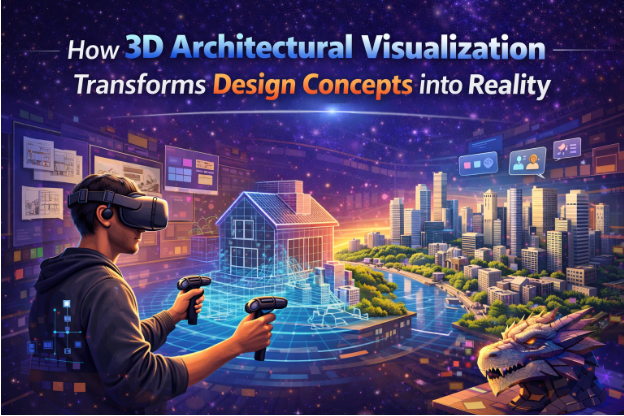
These architectural designs may begin in the form of sketches, mood boards, or conceptual drawings. Although these are very important in terms of creativity, they are not very communicative of the complete project in front of clients, investors, or other stakeholders. It is at this point that 3D architectural visualization can prove very helpful in bridging the gap between creativity and implementation.
Visualization helps individuals to appreciate the design of the project through design intentions translated into detailed digital environments before any construction can take place. In return, this allows greater alignment and greater confidence with any design decisions made.
Abstracts Made Concrete and Realised
The conventional blueprints and 2D diagrams require many technical skills to interpret them. Also, conceptualizing scale, depth, and relations spatially from 2D diagrams might not be that easy for most stakeholders.
Visualization ends uncertainty by representing areas in lifelike environments.
An observer can look at it and instantly know:
- Spatial flow and proportions
- Material finishes and textures
- Natural lighting and artificial lighting behavior
- The relationship between interior and exterior elements
This turns concrete experience into more abstract notions that are tangible, real, and possible.
Improving Accuracy Early in the Process
Three-dimensional visualization of the project will indicate the flaws in the design at a very early stage. It is much easier to point out flaws in a structure as a whole environment.
Design teams can observe:
- Proportion or scale issues
- The computer-inefficient
- Poor lighting/visibility
- Materials that do not match well
This helps to detect a lot of concerns early, thereby avoiding really expensive alterations once the project goes into either construction or the build phase. Hence, the intended design is left untampered.
Improved Communication with Clients and Stakeholders
Communication is the key in architecture, and it becomes even more crucial when there is more than one decision-maker. Visual communication is quite essential since it is the language of architecture. This does not leave any form of ambiguity.
Instead of providing an explanation or assumption, teams can show visual representations depicting precisely what the completed space will represent. This leads to:
- Faster feedback cycles
- More productive discussions
- Fewer misunderstandings
- Client confidence boosting
The more the outcome is apparent, the easier it gets to collaborate.
Enabling Faster and Smarter Design Choices
Design decisions slow down when the design options are hard to visualize. It is possible to make fast design decisions when visualization allows for the visualization of design options.
It allows clients to view the following with ease:
- Various designs of facades
- Color and material variations
- Interior space planning and furniture arrangement
- Lighting moods and atmosphere
Side-by-side comparison has made decision-making intuitive, and decisions are no longer delayed based on guesswork.
Communicating Emotionality Through Space
Architecture is functional and experiential. Visualization enables the conveyance of the emotion associated with a design, which may involve elements like warmth, luxury, openness, and innovation.
With realistic lighting, perspectives, and surrounding environment, images can convey the experience those interacting with the space will have.
This is more important for residential, hospitality, and commercial projects because experience has played an important role in such sectors.
Harmonization of Design & Marketing, and Development
It is even important in the post-design approval process. Visualization is used in the presentation of the project before its completion by designers and market experts.
These visual resources can be utilized with the help of 3D modeling services for:
- Advertisements and brochures
- Investor presentations
- Websites-Digital Listings
This will ensure that there is consistency in both the design intent and how the project will be delivered to market.
Mitigating Risk through Pre-Service Learning
Changes during construction are very expensive. Visualization reduces this headache as changes can be implemented virtually.
Through design plans inspected before the construction, the following advantages are realized in any construction project:
- Fewer revisions in designing
- Increased coordination among teams
- Less waste material
- The enhancement of budgetary control
This proactive approach safeguards both timelines and costs.
Smoothing the Path for Better Collaborations Between Teams
Building projects require architects, interior designers, engineers, and developers. Visualization gives a common point of reference that coordinates the activities of all other participants in building. The common visual construct makes collaboration far easier, and the resultant output will be a manifestation of a common vision rather than a collection of visions.
Conclusion
3D architectural visualization is one of those technologies that has brought a sea change in the design process, right from the idea to reality. The essence of the same lies in the fact that it ends all ambiguity associated with designing.
Visualization is the process, starting from developing the concepts and going all the way to facilitating the marketing and development phases, whereby one can be sure that what is envisioned gets actually created. In an industry where clarity, accuracy, and certainty mark success, architectural visualization becomes more of a need than a tool.
