

It used to be that there was a clear line between home security and smart home automation. The two were as distinct as their purposes. Home security was reactive and defensive. Home automation was proactive and life-enhancing. But what has happened to that line? It has not just blurred; it has completely disappeared.
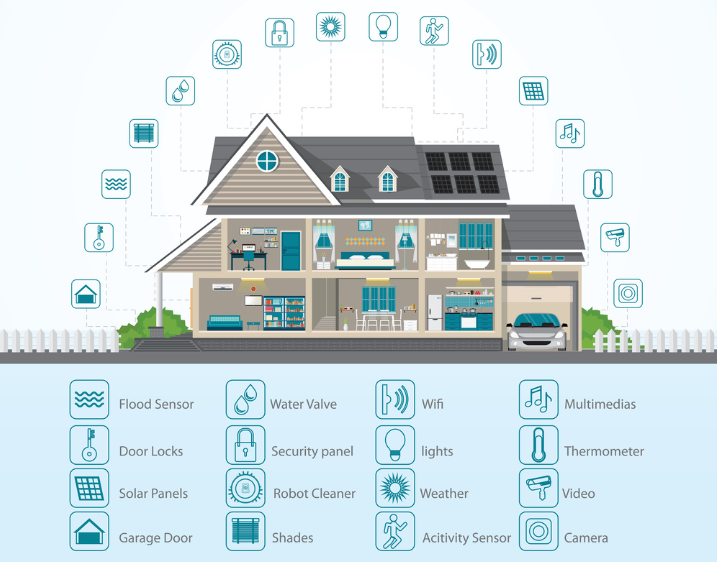
Today’s providers treat home security and home automation as two sides of the same coin. Devices from both categories are included in base systems. In addition, there is an expectation of at least some device overlap. Take the smart lock. It is both a security and a convenience device. It falls under both categories.
A Unified Smart Ecosystem
The move toward eliminating the line between home security and automation began with integration. Prior to integration, a homeowner might have had one app for all his security cameras and a separate app to control the thermostat. But now all those devices can be controlled by a single app as long as they rely on the same communication protocol.
Integrating through single apps or control centers led to the idea of unified smart ecosystems in which devices can essentially play off one another. For example, imagine a smart lock interacting with your lighting, thermostat, and security system.
With your phone on and listening for your voice, you say something like “welcome home” as you pull into the driveway. That command unlocks the front door, which, in turn, triggers a chain of events that:
- Disarm your security system
- Turn on the first-floor lights
- Adjust your thermostat to the preferred setting
Through this example, we can clearly see both home automation and home security working together. Integration through common protocols has made it possible.
The Rise of Artificial Intelligence
We have also seen significant changes to both home security and automation with the rise of artificial intelligence (AI). According to Vivint, a leading provider of both home security and automation systems, AI brings predictive intelligence to the table.
For example, an AI-enabled smart thermostat can artificially learn a homeowner’s routine and adjust programming accordingly. Likewise, an AI-enabled security camera can now intelligently distinguish between human beings and family pets.
AI enhances how home automation and security devices interact. Through predictive intelligence, modern systems are able to self-adjust in order to maximize both safety and convenience.
New Electronic Entry Points
Eliminating the line between home security and automation is mostly good. But there is one major drawback: integration introduces new electronic entry points into a home. Homeowners can no longer be content was simply securing doors and windows. They now need to secure their home networks along with each of the devices on their systems.
Integration means that every smart light fixture is an entry point. So is every security camera, smart lock, motion sensor, and thermostat. These devices are not necessarily physical entry points, but digital ones. They give criminals access to sensitive data without them ever having to break in.
An Effort Worth Making
Homeowners must make a concerted effort to protect their smart homes against digital intrusion. But from my experience, it is an effort worth making. A fully integrated home security and automation system increases safety, convenience, and efficiency. They are worth the trade-off of having to digitally harden my home against electronic intrusion.
Now that the line between home security and automation is gone, those of us active in the space are learning to do some amazing things with our systems. What used to be the stuff of sci-fi fantasy is quickly becoming reality. From my perspective, that’s good.
